


Holly Pimm
Unboxed perspectives: designing workplaces for diversity and wellbeing
5 June 2024
This year, for the first time, HOP was proud to be an official Fringe Partner of Clerkenwell Design Week 2024. The sun may not have been shining as much as usual, but our studio was alive with a buzz; and not just from the flowing drinks!
The HOP team welcomed a handful of workplace experts, landlords and end users to join us for a lively roundtable discussion, exploring how we can all create more inclusive workplaces.
We hosted the roundtable in partnership with acoustic treatment specialists Resonics, and leading acousticians Hawkins & Associates. The discussion provided a particular focus on the importance of acoustics as we begin to understand more about how sound can negatively, or positively, massively impact our workplace experiences.
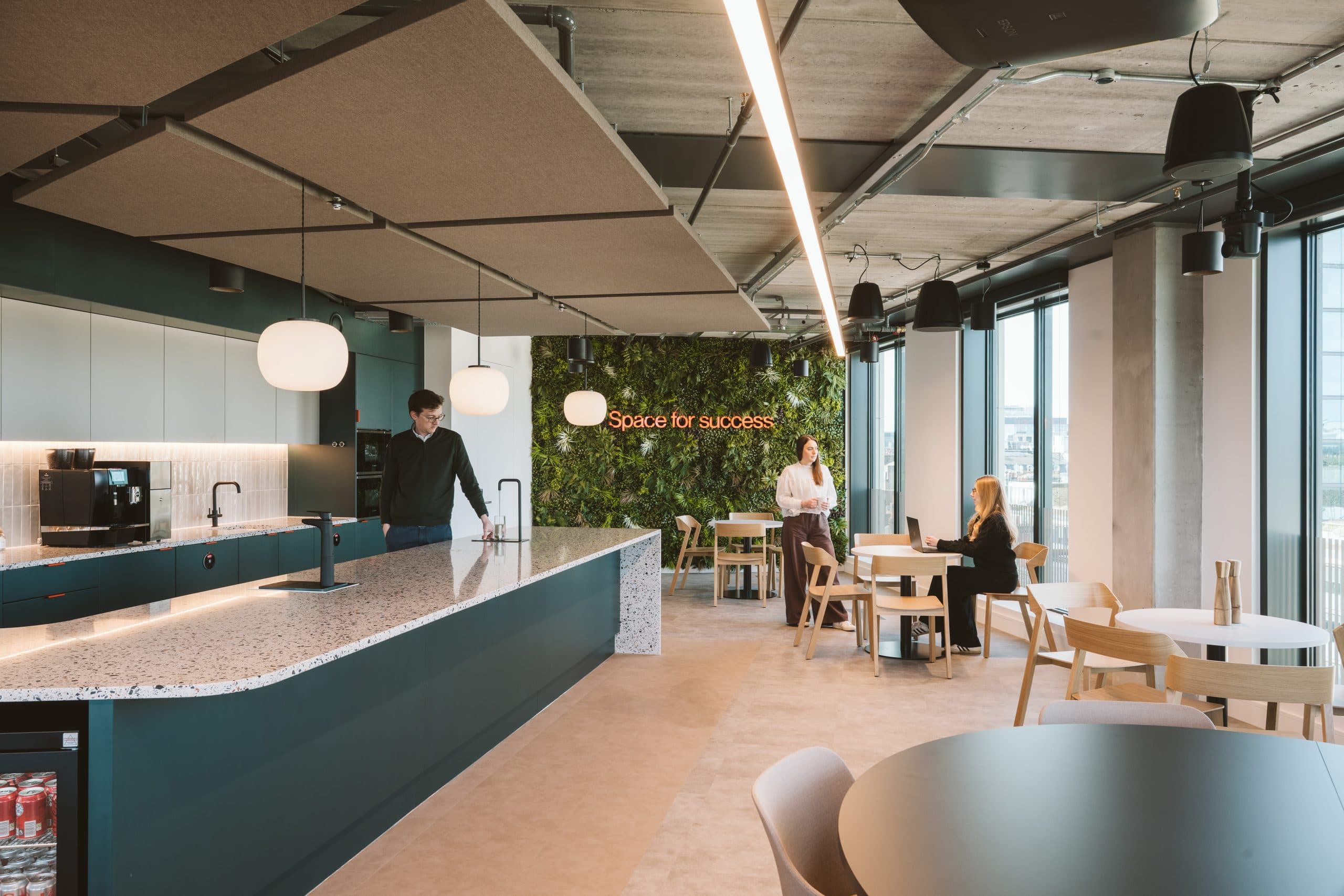
The talk was complemented by an acoustic installation in the HOP studio from Resonics and JUMP Joinery called ‘Unboxed Perspectives’, to show us the beauty of not fitting in the box and celebrating the variety that diverse perspectives bring to the workplace.

Joining us for the roundtable we were lucky to have an extremely diverse and experienced group of experts spanning across all disciplines.
Joining Josh Towle, Creative Director, and Alicia Spibey, Interior Designer, from HOP, we also welcomed:
- Rosalind Lambert-Porter, MD (Acoustics) at Hawkins & Associates
- Bolívar Marcon Pinheiro Machado, Workplace Design Manager Lead at Landsec
- Philip Bentley, Group Head of Premises at Mott Macdonald
- Sarah Bewers, Coach and Founder at Lead With Health
- Andy Love, MD at Love Design Studio
- Lewis Harman, Business Development Director at Hunters Contracts.
Read on below to hear our roundtable roundup…

Much like sustainability, ‘inclusivity’ and ‘diversity’ have become industry buzzwords, but they are also extremely important pillars of workplace design. Everyone knows they need to create an inclusive workplace, but there isn’t a framework that offers measurable outcomes or benchmarks for success.
Before we started the discussion, we asked our roundtable to define what inclusivity is to them and why it matters.
Josh: Diversity and inclusion are sometimes treated as though they are interchangeable, but there’s a crucial difference – as summarised in this brilliant quote from Verna Myers: “Diversity is being invited to the party: Inclusion is being asked to dance.” Designing an inclusive environment does not mean focusing on physical differences; there has to be an equal emphasis on different styles of working as well as on mental health.
Sarah: when I think of inclusivity, I think of belonging. And in terms of belonging in the workplace I think there are two strands: there’s the physical, and then there’s the social-emotional. And the physical environments we spend our time in need to support the social and emotional feeling of belonging.

How do we make workplaces inclusive, so everyone has the opportunity to thrive and give their best at work?
Alicia: As designers we are constantly trying to make workplaces work harder, but I think this has actually caused functionality and occupier wellbeing to drop. You can’t physically design a comfortable space that has every single function in one room.
Flexible spaces have become increasingly popular. However, in practice, people often don’t use these spaces as intended. If a room has a big operable wall, people are hesitant to move it. They don’t want to mess up the space or change it in a way that might not suit others.
It definitely needs to be a bigger cultural piece. And we as designers have a responsibility to communicate this to our clients to aid them in their designs.

The discussion then moved onto finding the right balance for people and businesses when designing for the minority vs the majority, and whether it is possible to design a workplace that caters for everyone.
Ros: I think you can. But you have to make sure you’re partitioning out the space correctly, whether that be physically or culturally. Employers need to decide where people are going to do different things and communicate this as a change management piece. I think a lot of people, particularly neurodivergent people, like to know the rules.
As an example, virtual meetings are the worst things to have happened to open plan offices. Open plan is still a popular design choice to encourage a transparent and collaborative culture, but we aren’t designing open plan offices to work with the amount of virtual meetings people are still having. We need to create separate technology-enabled areas, and then communicate to people how they are meant to be used.
Philip: We know that employee wellbeing is crucial to our success. We are lucky in the sense that we do three or four projects a year, so we’re continually learning.
We have learnt a lot about neurodiversity from our staff health and wellbeing feedback. We’ve learnt that pretty much everyone is sensitive to noise in some shape or form, just some people are more sensitive. So if you design with the most sensitive people in mind, you’re actually improving the workplace experience for everyone and not just that minority group. The minority group should be your baseline for best practise.
Our participants then started discussing some of the challenges they have come up against in recent years regarding neurodiversity in workplace design, and what we can do to combat them.
Andy: when we talk about creating a comfortable environment for neurodiverse people, there are so many factors to consider. Acoustics and lighting levels are two of the biggest elements in a space that can negatively affect people.
We’ve found, quite often, clients say they offer a comfortable working environment without actually calculating howthey offer a comfortable working environment. So how can they validate that?
We have started running thermal comfort analysis to actually help our clients validate these claims. And we want to start seeing that, as an industry, organisations will start to use science to back their claims and have data-driven measures of success.
Ros:When a client hands me a floorplan, I will always ask: where are people going to go to concentrate? Where are people going to go to socialise? Where are people going to go to escape? Because all of those different things will have their own acoustic requirements.
Often they will have a vision that they want to incorporate all of these areas into one room. And what you end up with is people, whether they’re neurodivergent or neurotypical, sitting there with headphones on to escape the place that they’re working in because the acoustics, and probably a lot of other things, are poor.
There’s a misconception that making a space acoustically suitable involves large, obtrusive elements like high screens or boxes on walls. However, good acoustic design doesn’t have to be intrusive. If it works for neurodivergent individuals, it will work for the entire workforce.

And how can the workplace help bring diverse groups of people together?
Bolivar: we quite often design large, central breakout areas for offices with different kinds of seating. For example a beautiful, feature modular sofa in the middle of the room with high tables surrounding it, and… no one sits on them.
It’s similar to if you go to an airport lounge – do you go to the open lounge sofa in the middle where you feel exposed and as though everyone can hear and see what you’re doing? Or do you try and find a corner booth seat a bit more tucked away for privacy? We are discovering more and more, in particular with neurodivergent people, people don’t like to be overseen while they’re working. So why are we still designing so many open lounge areas?
Josh: I agree, I think it’s a complete misconception. You think that everyone’s going to dive straight into the breakout areas and want to be chatting and socialising with their colleagues every day over lunch.
But actually, you might have neurodivergent people within that workplace that want to go and eat their lunch on their own. So are we providing these options for them?
Maybe we should be producing more flexible furniture within these areas, such as banquette seating that can be wheeled to different areas. There needs to be areas where neurodiverse people can breakout and relax in their own way.
Lewis: Before COVID, sustainability and other considerations like acoustics may have been viewed as nice-to-have rather than essential. We’ve been on projects where sustainability initiatives were among the first things to be cut when budgets were tight.
However, there’s a clear link between these elements and the overall success and functionality of a space. For instance, a tidy room may seem inconsequential, but it can greatly impact productivity and the overall atmosphere of a workplace.
It’s essential to weigh the cost implications against the long-term benefits of inclusivity, sustainability, and other aspects of workspace design. Encouraging dialogue around these topics can help align expectations and priorities moving forward.

What activities or initiatives have you implemented (or seen implemented) for staff wellbeing and to support creating a positive workplace culture? What do we need to incorporate into our designs?
Sarah:I think that the wellbeing piece is massive. There’s a real tangible part of wellbeing (physical health), but then there’s the emotional, mental, social, spiritual aspects that are now becoming more and more important, and these mean very different things to different people.
We need to create environments that allow people to create their own safe space. If a company has the right cultural attitudes towards that, as well the physical conditions and environment to do so, then that is when employee wellbeing is truly considered.
Alicia:I think space ownership is key for employee wellbeing, which is really hard to do in an environment where a lot of people are hot desking and people are not allowed to have their own space. A few years ago, it was all about neighbourhoods and giving teams ownership of a space, whereas recently we’ve started moving away from designing neighbourhoods as it creates siloed teams.
How do we provide opportunities for ownership, as well encouraging collaboration? Maybe we offer teams smaller pockets of space that they can use and personalise to feel like they’ve added value and feel comfortable.
Ros: Simple solutions, like providing a designated space for private phone calls, can significantly improve office dynamics. Acoustic design can also influence behaviour, such as controlling voice levels through space design.
Sensory wellness is crucial for creating productive and comfortable work environments.

And finally, have we come full circle in any way over the past couple of years?
Bolivar: I think the workplace has gone through a big evolution in the last two decades. Companies started by wanting to make the workplace fun so employees didn’t want to leave; they started adding PlayStations, games, playful colours. But then, it was suddenly too much fun. The hotelification of the office was then introduced, making the office a bit more amenity-focused with a home away from home feel.
But now, I think we’re coming back round to wanting an office that acts like an office, not pretending to be something it’s not. The office is a place where we want to get our work done. And what does this look like? A place where the technology works seamlessly, the acoustics are perfect for comfort and efficiency, and you can collaborate easily in person and virtually.
The office has its own space in society; it doesn’t have to be a home, it doesn’t have to be a hotel, and it doesn’t have to be a playground. It needs to be a place where you can do your best and be your best at work.
Josh: I think we’ll start bringing back some siloed working elements to the office. With everyone working from home for a sustained period, we’ve now realised that both focus and collaboration are of equal importance, and both with very different space requirements. Now people are coming back to the office for good, we need the private space, but an evolved version of what it once was.
Ros: Post covid, acoustics have risen again in popularity, but this time driven by the client and not the dealers and manufacturers. Clients now know the acoustic specs they need, but there are still some products out there which aren’t acoustically giving the best results. It’s important that we get the right products and information out there for people to actually create acoustically comfortable spaces, rather than just looking like them.
Summary:
And this is just a snapshot of the hour and a half conversation. The roundtable covered a lot of important topics, as well as key challenges that workplace experts, landlords, and end-users are facing in today’s hybrid landscape when trying to create inclusive and comfortable spaces.
What have we discovered? As we continue to evolve and learn, designing for diversity and wellbeing is a journey and not a destination.
It is the responsibility of workplace creators to ensure we do not forget anyone, and that the physical spaces we create support and enable inclusive cultures.
As we continue this conversation at HOP to pursue how we can do this for our clients, we would love to know – how and why is diversity, wellbeing, and inclusion important to you?